
Pirapitinga
The Tambaqui’s Toothier Cousin
Pirapitinga
The Tambaqui’s Toothier Cousin
Guide
Often mistaken for its close relative, the tambaqui, the pirapitinga is a powerful, deep-bodied omnivore that thrives in the diverse aquatic environments of the Amazon Basin. Known locally as caranha, this species can reach impressive sizes—up to 85 cm in length and over 20 kg—and is prized both for its strength and as a table fish.
While similar in shape and behavior to the tambaqui, pirapitinga can be distinguished by several features, including the presence of conical teeth, a more prominent adipose fin with soft rays, and a body coloration that often shifts from silvery to reddish hues in the fins and flanks, especially in juveniles. Its preference for fruit, seeds, and nuts is a hallmark of the species, but adults will also take small fish and invertebrates when the opportunity arises.
Pirapitinga are gregarious and migratory, often traveling long distances to spawn. They are most often encountered in oxbows, flooded forests, and lakes off major river channels, where their diet plays a key ecological role in seed dispersal and nutrient cycling. Anglers will find these fish aggressive, resilient, and thrilling on both bait and artificial lures—especially when targeting them during their seasonal movements.
Interesting Facts & Notes
Pirapitinga can be difficult to distinguish from the tambaqui —but have conical teeth and a divided premaxilla, unlike the tambaqui's molariform dentition and fused upper jaw.
Juveniles often show a silvery or slightly purplish hue with reddish fins; adults darken over time.
Their fruit-heavy diet makes them key agents of seed dispersal in flooded forests.
Where to Catch
Pirapitinga are not a primary target on most Acute Angling trips, but they are occasionally encountered during multi-species fishing adventures:
Peacock Bass Fishing Trips - Encounter multiple species while casting for peacocks
Quick Facts
| Attribute | Description |
|---|---|
| Scientific Name | Piaractus brachypomus |
| Common Names | Pirapitinga, Caranha |
| Size Range | Common: 10–20 lbs; Max: 40+ lbs |
| Region | Amazon and Tocantins–Araguaia basins |
| Habitat | Flooded forests, oxbows, marginal lakes |
| Behavior | Schooling, migratory omnivore |
| Coloration | Silvery or light brown; reddish fins (juveniles); darker with age |
| Aggression | Moderate – will strike baits and lures, especially during high feeding activity |
| Feeding Habits | Omnivorous – fruits, seeds, invertebrates, and small fish |
| Gamefish Status | High – powerful, fast runs; excellent on light tackle |
Physical Appearance
Pirapitinga are laterally compressed with a rounded to rhomboid body shape. They lack the pre-dorsal spine of some relatives and have small eyes, a blunt snout, and a relatively small mouth armed with conical teeth. Their body is covered in large cycloid scales, usually silvery to gray-brown in color, while the fins (especially in juveniles) are often reddish-orange. The caudal fin is deeply forked, and a visible adipose fin with rays sets them apart from the tambaqui.
How to Identify a Pirapitinga
Body Shape: Deep, rhomboidal body similar to tambaqui
Teeth: Conical teeth and divided premaxilla (vs. tambaqui’s molariform teeth)
Adipose Fin: Present and ray-supported (vs. soft and rayless in tambaqui)
Fins: Reddish in juveniles; darken with age
Jaw: Short, curved upper jaw with powerful bite
How to Catch Pirapitinga
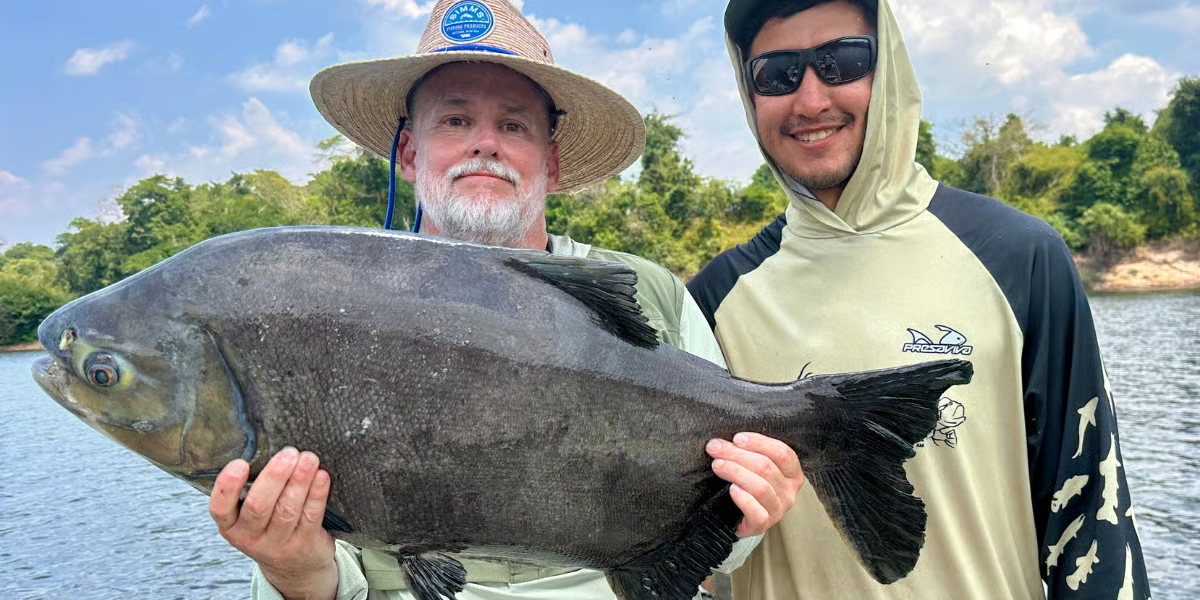
Pirapitinga are strong, wary fish that demand stealth and strategy. They can be caught using both natural baits and artificial lures when feeding actively.
Recommended Techniques
Natural Baits: Fruits (seringa, figs), worms, fish chunks, cow heart, or dough balls
Artificial Lures: Medium-sized spinners, spoons, and diving plugs (10–20 cm); half-water plugs are especially productive
Fly Fishing: Use 9–12 wt rods with streamers or fruit imitations (e.g., poppers or divers)
Suggested Gear
Rod: Medium to heavy baitcasting or spinning rods; bamboo rods for traditionalists
Line: 30–50 lb test
Hooks: 3/0 to 5/0 circle or J-hooks with wire or fluorocarbon leaders
Tips: Target eddies and shaded backwaters near riparian forest. Cast close to vegetation or near overhanging fruit trees.
Related Reading
Join The Adventure
Hook into the Amazon’s hardest-hitting herbivore on an epic jungle fishing trip with Acute Angling.
Contact us today:
📞 (866) 832-2987
References
Ferreira, E. et al. (1998)
Goulding, M. (1981). Amazon: The Flooded Forest
Santos, G.M. et al. (2006)
Melo, M.R.S. et al. (2005)
Araújo-Lima & Goulding (1998)
Zeinad, A. K. & Prado, R. A. (2012). Peixes fluviais do Brasil: espécies esportivas


