
Freshwater Stingrays
The Amazon’s Hidden Gliders
Freshwater Stingrays
The Amazon’s Hidden Gliders
Guide
Freshwater stingrays are among the Amazon’s most fascinating and mysterious aquatic inhabitants. Often seen gliding over sandy bottoms or buried in the shallows, these disc-shaped fish belong to the family Potamotrygonidae—a diverse group of cartilaginous rays found only in South America. They’re the only group of stingrays adapted exclusively to freshwater and have evolved into more than 30 recognized species, many of them endemic to specific river systems.
Although they’re not a primary target on most fishing trips, stingrays play a crucial role in Amazonian food webs. Anglers may encounter them while fishing natural baits on the bottom, and they should be handled with extreme caution. Some specimens reach over 3 feet across and carry powerful venomous barbs on their tails that can cause serious injury if stepped on or mishandled. Despite their danger, stingrays are elegant swimmers and stealthy predators—feeding on fish, crustaceans, mollusks, and insect larvae.
Freshwater stingrays are important both ecologically and culturally. In some parts of the Amazon, they’re increasingly targeted for the aquarium trade due to their striking patterns. Others are consumed locally, and some are used in scientific research. Whether spotted in the wild or encountered on the end of a fishing line, they leave a lasting impression.
Interesting Facts & Notes
Potamotrygonidae is the only family of stingrays that lives exclusively in freshwater.
The Paraná basin is home to the largest specimens, including Paratrygon aiereba, which can exceed 1 meter in diameter and weigh over 50 kg.
Stingray barbs can regenerate after being lost or broken.
Some species exhibit striking dorsal patterns used to distinguish between genera and even individuals.
Stingrays are ovoviviparous, giving birth to fully formed young after internal development.
Where to Catch Stingrays
Stingrays can be found throughout the Amazon basin and while not targeted on any specific trip, can be found where least expected. Keep on the lookout everywhere you go!
Quick Facts
| Attribute | Description |
|---|---|
| Scientific Name | Potamotrygon spp., Paratrygon spp., Plesiotrygon spp., Heliotrygon spp. |
| Common Names | Arraia, Arraia-de-água-doce, Freshwater stingray |
| Size Range | 30–100+ cm disc diameter; up to 50+ kg in some species |
| Region | Amazon, Paraná, Orinoco river basins |
| Habitat | Sandy or muddy bottoms in shallow margins, deep holes, lagoons |
| Behavior | Solitary or small groups; often buries in substrate |
| Coloration | Highly variable: spotted, marbled, or reticulated patterns |
| Aggression | Passive but dangerous if stepped on or provoked |
| Feeding Habits | Carnivorous; preys on fish, mollusks, insect larvae, and crustaceans |
| Gamefish Status | Not commonly targeted; considered a secondary catch |
Physical Appearance
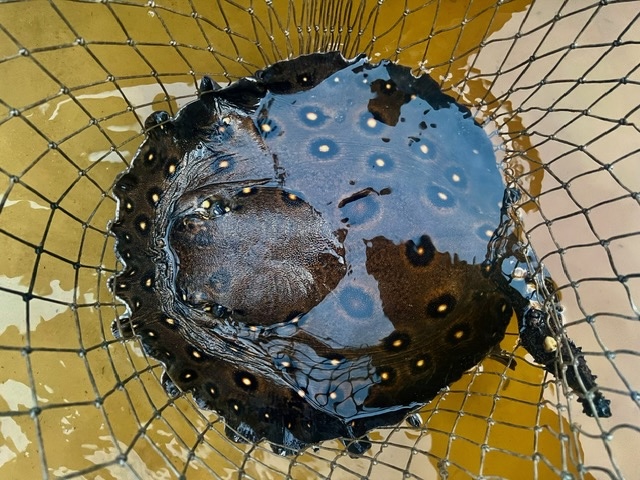
Freshwater stingrays have a circular or oval disc-shaped body with a flattened appearance. Their dorsal surface is decorated with patterns that vary greatly by species—ranging from simple spots to complex rosettes or geometric markings. Their eyes sit atop the head, giving them a wide field of view even while buried in sediment.
Their tail is long and whip-like, usually bearing one or more venomous barbs. In Paratrygon and Plesiotrygon, the tail is thicker and often longer than the disc itself. Species like Potamotrygon motoro are easily recognized by their striking orange or yellow spots on a dark background.
How to Identify a Stingray
Eyes on dorsal surface
Large, disc-shaped body
Spiracles (breathing openings) behind the eyes
Venomous spine on tail (in most species)
Fishing Tactics: How to Catch Freshwater Stingray
Although not a primary sportfishing target, stingrays are occasionally caught while bottom fishing with natural baits. Their strong suction-feeding behavior allows them to slurp up bait without warning, and their fights are heavy and dragging.
Recommended Techniques
Bottom fishing near riverbanks or in deep sandy holes
Night fishing increases encounter chances
Use natural baits (fish chunks, worms, shrimp)
Suggested Gear
Medium-heavy or heavy spinning/conventional rods
50–80 lb braided line
Circle hooks (8/0–12/0) with strong leader
Gloves or dehooking tools to avoid contact with tail
Handling Warning: Stingrays should only be handled by experienced anglers. Always keep the tail secured and the spine facing away from you. Use pliers or wet towels to avoid injury.
Related Reading
Join The Adventure
Want to encounter the Amazon’s most elusive gliders? Book an adventure with Acute Angling and explore the wild backwaters where these fascinating rays roam.
Contact us today:
📞 (866) 832-2987
References
Carvalho, M.R. de, Lovejoy, N.R. (2003). Morphology and systematics of freshwater stingrays (Potamotrygonidae).
Giarrizzo, T. & Sousa, L. (2021). Peixes Fluviais do Brasil: Espécies Comuns da Ictiofauna Continental Brasileira.
Zeinad, A. K. & Prado, R. A. (2012). Peixes fluviais do Brasil: espécies esportivas.
Britski, H.A., Sato, Y., Rosa, A.B. (2007). Manual de Identificação de Peixes da Região do Tocantins-Araguaia.
Silva, J. P. & Uieda, V.S. (2011). Feeding ecology of freshwater stingrays in the upper Paraná River.


